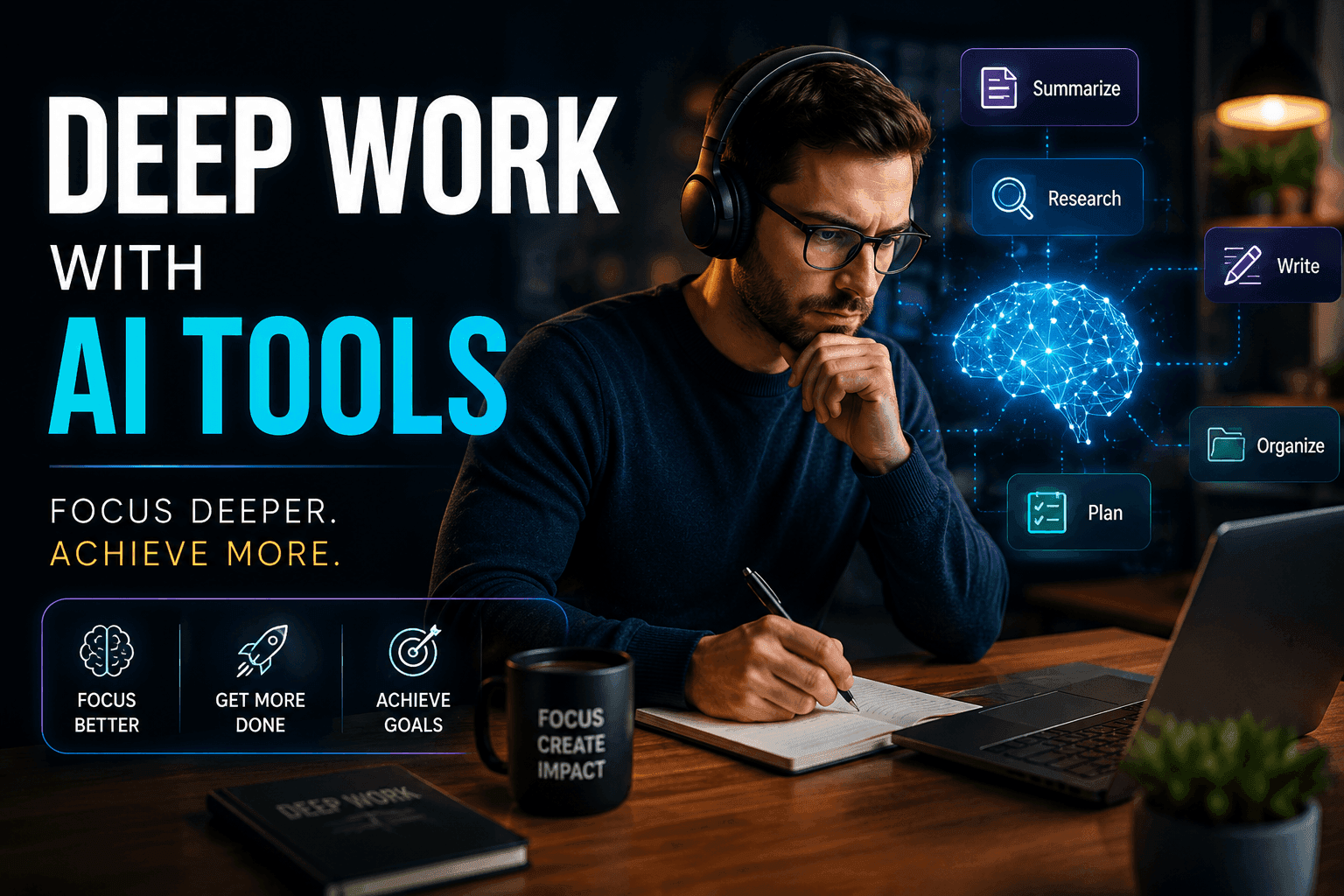
Deep Work with AI: The Modern Productivity Guide
Focused, distraction-free work remains one of the most valuable productivity skills in the AI era. Discover how professionals can combine deep focus sessions with AI productivity tools to complete high-impact work faster while avoiding the distraction trap of constant automation.
Artificial intelligence is changing how we work. From content creation and coding assistance to research and task automation, AI tools promise to save hours every week. Yet many professionals report feeling more distracted than ever.
Why?
Because productivity isn't just about doing more tasks. It's about doing the right work at the highest level of concentration.
This is where deep work becomes essential.
Rather than replacing focused thinking, AI can become a powerful companion that amplifies focus sessions and helps knowledge workers produce better results in less time.
In this guide, you'll learn how to combine focused work principles with modern AI tools to create a productivity system that maximizes both focus and output.
What Is Deep Work?
The concept of high-value work was popularized by productivity author Cal Newport.
This refers to:
Professional activities performed in a state of distraction-free concentration that push your cognitive capabilities to their limits.
Examples include:
- Designing software architecture
- Writing strategic business plans
- Learning complex technical skills
- Solving difficult engineering problems
- Creating high-quality content
- Conducting in-depth research
These activities generate significant value because they require sustained attention and advanced thinking.
In contrast, shallow work includes checking emails, responding to notifications, attending unnecessary meetings, or constantly switching between tasks.
Why Deep Work Matters More Than Ever
Many people assume AI will make focus less important.
The opposite is true.
As AI reduces the effort required for routine tasks, human value increasingly comes from:
- Strategic thinking
- Problem solving
- Creativity
- Decision making
- Innovation
- System design
These are precisely the activities that benefit most from distraction-free work.
Professionals who can maintain intense focus while effectively leveraging AI will have a significant advantage over those who rely solely on automation.
The Problem: AI Can Either Boost or Destroy Focus
AI tools can save time, but they can also become another source of distraction.
Common productivity traps include:
- Constantly testing new AI tools
- Excessive prompt tweaking
- Switching between multiple AI platforms
- Generating information without taking action
- Over-automation of simple tasks
Many workers spend hours interacting with AI without producing meaningful outcomes.
The goal is not to use AI more.
The goal is to use AI better.
How AI Enhances Deep Work
When used intentionally, AI can eliminate low-value cognitive tasks and protect your focus for higher-value work.
Research Acceleration
Before starting a focused work session, AI can help:
- Summarize articles
- Extract key insights
- Organize research notes
- Generate topic outlines
Instead of spending an hour collecting information, you can begin focused thinking with a structured knowledge base.
First-Draft Generation
AI excels at creating rough drafts.
Examples include:
- Blog outlines
- Product requirement documents
- User stories
- Meeting summaries
- Technical documentation
This reduces activation energy and allows professionals to focus on refining ideas rather than starting from a blank page.
Task Breakdown
Large projects often create mental resistance.
AI tools can break complex goals into:
- Milestones
- Deliverables
- Daily tasks
- Priority sequences
This makes it easier to enter a state of concentrated work because the next action is always clear.
Knowledge Organization
Modern AI assistants can help organize:
- Notes
- Research databases
- Project documentation
- Learning materials
A cleaner information system reduces cognitive load and improves concentration.
The Focused Work + AI Framework
The most productive professionals follow a simple pattern:
Phase 1: Prepare with AI
Spend 10–15 minutes using AI to:
- Gather information
- Create an outline
- Clarify objectives
- Define deliverables
Avoid getting stuck in endless conversations with the tool.
Phase 2: Enter Deep Work
Turn off distractions and focus exclusively on execution.
During this stage:
- Disable notifications
- Close unnecessary tabs
- Avoid social media
- Work on a single objective
This is where the real value is created.
Phase 3: Review with AI
After the deep work session:
- Refine output
- Check for missing information
- Improve clarity
- Generate improvement suggestions
AI acts as an editor rather than the primary creator.
Best AI Tools for Deep Work
ChatGPT
Useful for:
- Research summaries
- Idea generation
- Writing assistance
- Coding support
Notion AI
Excellent for:
- Knowledge management
- Meeting notes
- Project documentation
- Team collaboration
Claude
Particularly effective for:
- Long-form analysis
- Strategic thinking
- Large document processing
Perplexity
Ideal for:
- Research
- Fact gathering
- Source discovery
ProductiveVibe
A productivity-focused platform that helps users:
- Manage tasks
- Track goals
- Maintain focus
- Build sustainable workflows
Combining AI-generated planning with a structured task management system creates a powerful productivity environment.
Building a High-Focus Work Schedule
A practical schedule might look like this:
Morning (9:00–11:00)
Deep work block:
- Coding
- Writing
- Design work
- Strategic planning
Midday (11:00–12:00)
Administrative tasks:
- Emails
- Messages
- Meetings
Afternoon (1:00–3:00)
Second deep work block:
- Problem solving
- Project execution
- Learning
End of Day (4:30–5:00)
AI-assisted review:
- Summarize progress
- Plan tomorrow's priorities
- Update project documentation
This structure protects your highest-energy hours for meaningful work.
Common Mistakes When Combining AI and Deep Work
Using AI as a Substitute for Thinking
AI should enhance thinking, not replace it.
The most valuable insights still come from human judgment.
Multitasking During Focus Sessions
Avoid:
- Checking emails
- Reading notifications
- Switching projects
Every interruption reduces cognitive momentum.
Over-Reliance on Automation
Some tasks should remain manual because they develop expertise.
Learning, analysis, and decision-making are examples where active engagement matters.
Chasing Every New Tool
The productivity market introduces new AI tools every week.
Most professionals only need a small, reliable toolkit.
Focus on workflows rather than software.
Final Thoughts
Deep work is not becoming obsolete because of artificial intelligence. It is becoming more valuable.
AI can eliminate repetitive tasks, accelerate research, and improve organization. However, meaningful breakthroughs still require focused attention and sustained thinking.
The professionals who thrive in the coming years will not be those who use the most AI tools. They will be those who combine AI efficiency with deep work discipline.
By treating AI as a productivity multiplier rather than a distraction, you can produce higher-quality work, learn faster, and achieve more meaningful results.
Ready to Build a Better Productivity System?
Use AI to plan your projects, then organize your priorities and track execution with ProductiveVibe's interactive productivity tools. The combination of deep work and structured task management is one of the fastest paths to sustainable high performance.